Anxiety has a way of shrinking the world until your worry is the only thing in it. The Quran does the opposite: it re-opens the frame — reminding you who is actually in control, what actually lasts, and that you were never carrying any of this alone. These verses aren't a replacement for professional help when anxiety is clinical; they are the spiritual ground to stand on while you take every other good measure.
Verses That Calm an Anxious Heart
1. Hearts find rest — Quran 13:28
"Those who believe and whose hearts find rest in the remembrance of Allah — truly, in the remembrance of Allah do hearts find rest." The Quran's own answer to anxiety, stated as a law of the heart.
2. With hardship comes ease — Quran 94:5–6
"For indeed, with hardship comes ease. Indeed, with hardship comes ease." Whatever you're inside right now, ease is already threaded through it — the promise is repeated so you don't miss it.
3. Never beyond your capacity — Quran 2:286
"Allah does not burden a soul beyond what it can bear." The load feels impossible; this verse is Allah's testimony that it is not — you were built for this test.
4. Nothing befalls us but what He decreed — Quran 9:51
"Say: nothing will befall us except what Allah has decreed for us; He is our protector. And in Allah let the believers put their trust." The antidote to the endless "what if" spiral: the future belongs to Allah, not to your worst-case imagination.
5. Do not grieve — Quran 9:40
"Do not grieve; indeed Allah is with us." Spoken in a cave with pursuers steps away — proof these words work under pressure far greater than ours.
6. Sufficient for us is Allah — Quran 3:173
"Sufficient for us is Allah, and He is the best disposer of affairs (hasbunallahu wa ni'mal wakeel)." The words believers say when circumstances are stacked against them — and a dhikr you can repeat all day.
A Gentle Practice for Anxious Moments
- Breathe, then listen. Open one of these verses in Ayah Scroll and press play. Arabic recitation slows your breathing in a way silent reading doesn't — and the audio works offline, so it's there on the train, on a plane, anywhere anxiety finds you.
- Read the translation twice. Once for the words, once addressing them to your specific worry.
- Bookmark your verse. Everyone has one ayah that lands hardest. Save it, and pin it to your home screen widget so it's the first thing you see when you reach for your phone.
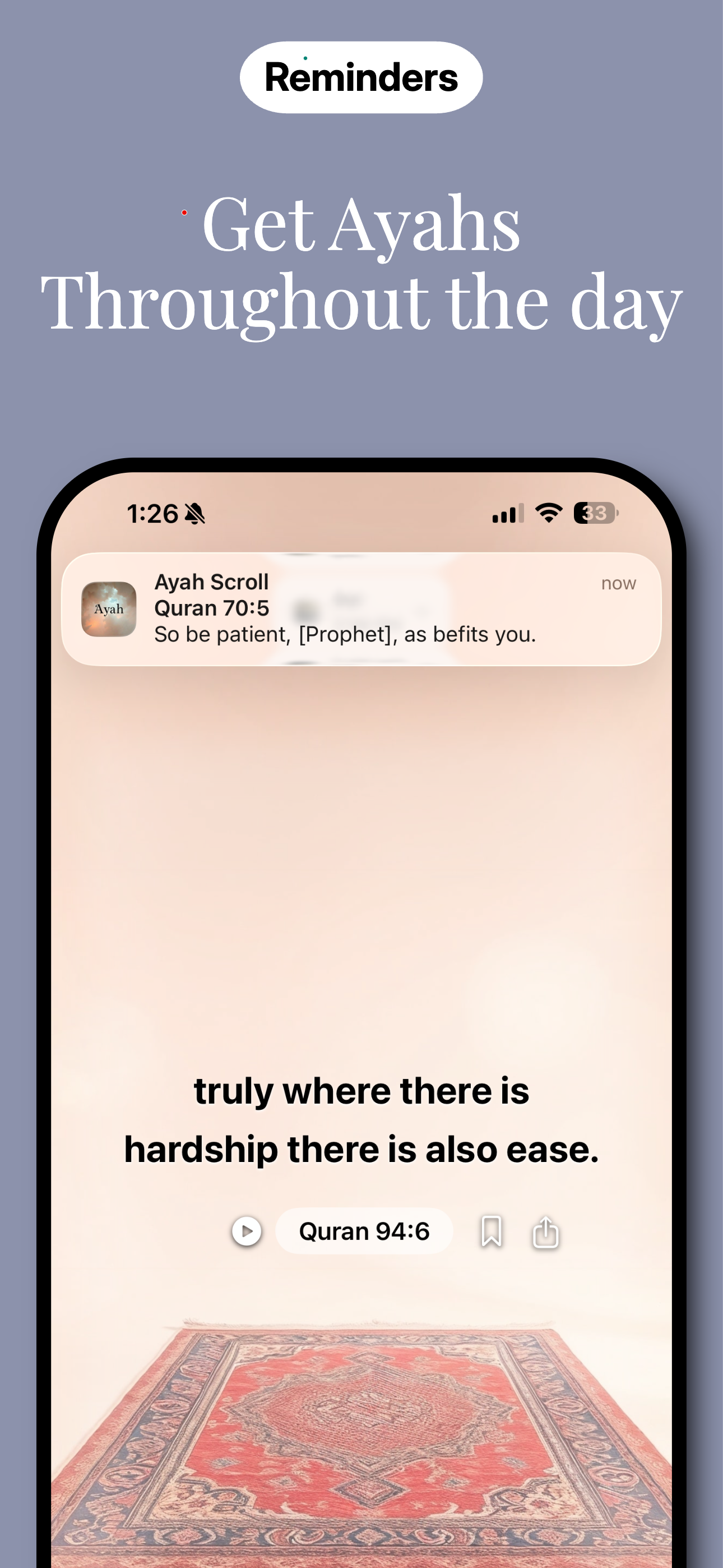
- Let verses come to you on hard days. Set daily reminders — a verse arriving mid-afternoon, unprompted, exactly when the day is heaviest, feels like a hand on the shoulder.

Frequently Asked Questions
Which surah is best to listen to for anxiety?
Surah Ar-Rahman (55), Surah Ad-Duha (93) and Surah Ash-Sharh (94) are widely loved for their soothing rhythm and reassuring themes. Short enough to listen to in full during a difficult moment.
Is it okay to seek therapy as well as turning to the Quran?
Yes — absolutely. Islam encourages taking every beneficial means (tying your camel and trusting Allah). The Quran nourishes the soul; qualified professionals treat clinical anxiety. They work together, not in competition.
What dua did the Prophet ﷺ make for anxiety?
Among them: "O Allah, I seek refuge in You from anxiety and grief..." (Bukhari). You'll find it with full Arabic, translation and source in Ayah Scroll's dua library under Health & Wellbeing.